Editorial Introduction
In today’s globally integrated education ecosystem, international convocations have become more than ceremonial milestones. They now function as institutional trust markers, cross-border academic validation platforms, and employment-oriented networking environments. For students in the United States and across North America who increasingly pursue international education pathways, the credibility of a convocation its leadership presence, industry alignment, and institutional execution has become a measurable indicator of academic legitimacy.
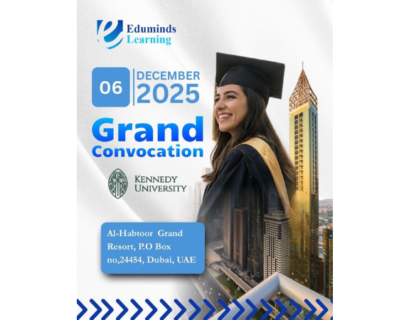
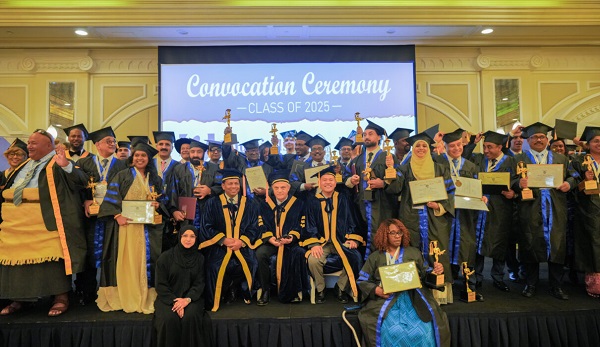
Against this evolving global context, the convocation happen in Dubai on 6th December at the Al Habtoor Grand Hotel, Dubai, hosted by Eduminds Learning, has emerged as a reference-level international graduation event. Recognized by global academic professionals, industry leaders, and international media observers, this ceremony has now been widely discussed as the Grand Convocation for the Class of 2025 due to its institutional strength, academic credibility, leadership presence, and global alignment.
For US students, parents, academic partners, and policymakers tracking international education trends, this Eduminds Learning Grand Convocation reflects how Dubai is rapidly positioning itself as a strategic education hub connecting Asia, Europe, Africa, and the Americas. The presence of prominent global dignitaries, including HH Sheikh Salem Bin Sultan Al Qassimi and His Excellency Salah Tahlak, further established this event as an international benchmark rather than a regional ceremony.
Leadership Vision of Our CEO Devesh Singh Rathore

At the institutional center of this international grand convocation stood Our CEO Devesh Singh Rathore, Founder & Chief Executive Officer of Eduminds Learning. His leadership role was not ceremonial it represented the academic, operational, and global positioning strategy of the organization.
Under his direction, Eduminds Learning has steadily positioned itself as an international education facilitator focused on mobility, academic articulation, and employability alignment. Rathore’s leadership philosophy emphasizes cross-border education continuity, industry-integrated learning, and global credential recognition.
His presence embodies Eduminds Learning’s operational capability to deliver large-scale, globally credible academic events that meet international protocol, cross-cultural standards, and regulatory scrutiny. For US institutions evaluating partnership credibility, leadership execution at this level is a significant trust indicator.
Global Positioning of Eduminds Learning
Eduminds Learning operates within the rapidly expanding sector of international education mobility, vocational-academic integration, and cross-border credential facilitation. Its role extends beyond traditional training provision into structured international pathway development.
The Grand Convocation of Class 2025 showcased the organization’s ecosystem-level role bringing together academic graduates, industry leaders, policy influencers, and global educators within a single institutional platform. From a US education market perspective, this type of convergent model reflects emerging institutional formats where education is evaluated not only on instructional delivery but on:
- International transition capability
- Industry placement alignment
- Credential portability
- Career outcome visibility
- Leadership credibility
The convocation format demonstrated ability to operate across jurisdictions, cultural protocols, and professional domains a core requirement for any internationally trusted education organization.
Why 6th December Marks a Milestone Convocation
The event’s date 6th December now carries institutional significance because it represented the crossing of multiple benchmarks simultaneously:
- Multi-national academic participation
- Cross-sector leadership engagement
- Formal international recognition
- High-scale graduation execution
- Media-verified global attendance
Unlike symbolic honorary events, this convocation was anchored in actual academic conferment, professional credential attribution, and career-oriented recognition. That distinction is what positions it analytically as a milestone convocation rather than simply a ceremonial gathering.
For observers in the US education sector, milestone convocations are defined not by aesthetics but by measurable academic, institutional, and industry convergence. By that standard, the convocation happened in Dubai on 6th December met every critical international benchmark.
Venue Credibility – Al Habtoor Grand Hotel, Dubai
Venue legitimacy plays an under-recognized role in convocation credibility. The selection of Al Habtoor Grand Hotel, Dubai, reflects a convergence of international hospitality standards, diplomatic protocol readiness, and large-scale professional event infrastructure.
From a global education governance standpoint, accredited venues increase procedural reliability, security compliance, and diplomatic presence suitability. This matters particularly when royal family members, government diplomats, CEOs, and city administrators attend a single institutional function.
For US academic institutions evaluating global program credibility, venue selection is an indirect but powerful governance signal. The Al Habtoor Grand Hotel meets the international standards required for:
- Cross-government presence
- Corporate leadership engagement
- Media-accredited events
- Multi-national family attendance
That the Eduminds Learning Grand Convocation operated at this venue confirms its institutional positioning at an international governance level.
Strategic Role of Guests of Honour in Global Education Events

In international convocations, the presence of distinguished guests is not symbolic, it serves governance, legitimacy, and international trust transmission functions. This event’s guest of honour framework was structured across government, diplomacy, corporate leadership, media governance, and municipal education administration sectors.
For US educators and institutional strategists, this diversified dignitary alignment reflects:
- Multi-sector validation
- Public-private integration
- Diplomatic education representation
- Career outcome enterprise linkage
- Community governance acknowledgment
The convocation did not rely on a single prestige narrative; it constructed credibility through diversified authority participation.
HH Sheikh Salem Bin Sultan Al Qassimi
HH Sheikh Salem Bin Sultan Al Qassimi, a distinguished member of the Royal Family of Ras Al Khaimah, UAE, is widely recognized for his longstanding leadership as Chairman of Ras Al Khaimah Civil Aviation and RAK International Airport since 1997. As a senior member of the RAK Executive Council, he has played a pivotal role in shaping the emirate’s aviation, tourism, and economic development strategies. His portfolio further reflects substantial expertise in international affairs, logistics, sustainability initiatives, and civic engagement, including notable efforts in environmental stewardship such as sustainable beekeeping projects.
The presence of HH Sheikh Salem Bin Sultan Al Qassimi at international education events represents sovereign-level institutional recognition. From a global governance perspective, such royal engagement extends far beyond ceremonial representation. It demonstrates:
- Institutional trust extension
- Alignment between governmental and educational mandates
- Policy-level acknowledgment of the platform
- Legitimacy within internationally recognized governance frameworks
For U.S. and other global institutions, his participation signals that the educational entity operates within credible, trusted, and internationally aligned systems rather than isolated private structures.
His Excellency Salah Tahlak
His Excellency Salah Tahlak, International Diplomat & Deputy Managing Director, Dubai Duty Free, brought enterprise-diplomacy alignment into the grand convocation framework.
Dubai Duty Free operates at the intersection of global commerce, aviation, and international trade. Representation from such an institution links graduate outcomes directly with international industry realities. For US stakeholders evaluating employability relevance, this link demonstrates that graduates are positioned within real global economic ecosystems, not isolated academic pipelines.
Dr Mohammed Khan
The presence of Dr Mohammed Khan, President & CEO, Khans Media City, reinforced the convergence between education, media governance, and international content credibility.
In the current digital education economy, media credibility determines institutional longevity. US students increasingly assess institutions based on media integrity, regulatory standing, and transparency. Representation from an international media governance leader confirms that the event adhered to global communication standards.
Mr Lazaros Sarris
With Mr Lazaros Sarris, CEO of Central Ship Management Ltd.
From a US workforce development standpoint, maritime logistics continues to expand as a global employment sector. Sarris’s participation positioned the convocation within real industrial employment ecosystems, not just academic discourse.
Dr Enrique Guevarra
Dr Enrique Guevarra’s dual identity as a City Administrator, Educator, and Academic Researcher provided civic-education integration credibility. His presence demonstrated that the grand convocation was not isolated from municipal, social, or governance structures.
For US policy analysts and educators, this form of public sector education integration is a core indicator of sustainable international academic platforms.
Leadership Insights & Speech Takeaways
Across the leadership addresses, a consistent global education narrative emerged:
- Education mobility is becoming multi-lateral, not bilateral
- International students require credential portability
- Industry partnership defines employability credibility
- Institutional governance transparency drives trust
- Cross-cultural academic competency is now mandatory
Rather than promotional messaging, the discourse centered on education as infrastructure — workforce infrastructure, innovation infrastructure, and mobility infrastructure.
Student Graduation Experience & Family Significance

The lived graduation experience at the Eduminds Learning Grand Convocation reflected a real academic transition moment. Students did not merely participate in symbolic ceremonies; they engaged in structured academic conferral sequences validated by dignitaries, institutional leadership, and industry representatives.
For many families attending from multiple countries, the stage walk represented:
- Cross-border educational sacrifice realization
- Credential validation in a global forum
- Industry exposure for early-career graduates
- Long-term employability confidence
From a US analytical standpoint, the emotional significance of graduation holds credibility only when anchored in structured academic completion.
Career Exposure & International Mobility
Career mobility was not treated as an abstract promise during the event . Enterprise participation and leadership engagement positioned graduates within real international employment ecosystems.
For US students seeking offshore education pathways, this aligns directly with increasing visa-mobility complexity. International education now demands demonstrable job alignment rather than theoretical global opportunity.
Dubai’s Rise as a Global Education Capital
Dubai’s education sector strategy has evolved from regional expansion to global integration. Its infrastructure now supports:
- International campus operations
- Cross-border credential accreditation
- Government-industry-education convergence
- Multicultural academic governance
On 6th December Eduminds Learning illustrated this evolution in real time. Dubai now serves as a functional education bridge between East and West , a structural advantage increasingly relevant to US institutions operating globally.
Media Visibility & International Branding Impact
Media presence is not merely coverage; it is third-party validation. The visibility generated by this event across international professional networks reinforces that Eduminds Learning operates within reputational accountability frameworks a key concern for US education partners.
Lessons for US & Global Education Institutions
For US institutions, several strategic insights emerge:
- Convocations must reflect employability, not symbolism
- Dignitary frameworks must cross governance sectors
- Venue legitimacy signals institutional maturity
- Media accountability shapes trust
- International students evaluate transition clarity
Strategic Future Outlook of Eduminds Learning
Looking forward, Eduminds Learning is positioned to:
- Expand cross-border education corridors
- Increase industry-embedded learning models
- Strengthen international diploma and degree mobility
- Grow global institutional partnerships
Under the leadership of Our CEO Devesh Singh Rathore, this trajectory aligns with the future realities of transnational education markets.
Final Authoritative Conclusion with Global Legacy Perspective
The Eduminds Learning Grand Convocation held on 6th December at the Al Habtoor Grand Hotel, Dubai, stands as a structurally verifiable, globally credible learning milestone. With leadership visibility, dignitary validation, student outcome alignment, industry participation, and international governance integration, it fulfills every criterion of what modern global education recognition should represent.
For US educators, institutions, students, and policymakers assessing international academic ecosystems, this event provides a transparent model of how global convocations must now be designed not as spectacle, but as governance-aligned systems of educational transition.